Style guide
The Ivy Cap
Also known as: ivy league cap, Jay Gatsby cap, duckbill cap
The ivy cap is the cleanest, most tailored member of the flat-cap family. The crown is low and rounded, made from two, four or six panels with no top button, and the brim is short, stitched and often snapped to the front of the crown. It earned its name from the Ivy League campuses of the 1920s and 1950s, where it was worn with tweed sport coats and chinos as a less rakish alternative to the newsboy.
History
The ivy cap descends from the British flat cap but was tightened up in 1920s America to suit collegiate dress. It became the everyday cap of golfers, university men and East Coast professionals through the mid-century, then quietly persisted as the cap your grandfather wore. Its current revival is driven by the heritage and Ivy/trad menswear movements that picked up steam in the 2010s.
How it's made
Most ivy caps use four or six panels rather than the scally's eight, giving a smoother, less puffed crown. The brim is short — usually 5 to 6 cm — and stitched cleanly to the front. Cloth is typically wool, tweed, cotton twill or linen depending on season.
How to wear it
The ivy cap is the most versatile of the bunch — it works with a sport coat, a chore coat, a chunky knit, or even tailoring. Sit it level and forward. Because the silhouette is so clean it can read modern, which is why you'll see it just as often on Brooklyn architects as on retired golfers.
The buyer’s handbook
A better cap starts with the right cut.
A cap can look right in a photograph and feel wrong on your head. Start with the shape, then choose cloth for the weather and measure before ordering.
Eight-piece, duckbill or flat?
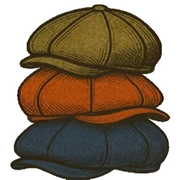
An eight-piece crown has wedge-shaped panels meeting at the top, creating a rounder, fuller silhouette; a newsboy often has a top button. An ivy or driver cap sits closer to the head with less volume. A duckbill tapers tightly toward the peak, while “flat cap” is often used as the umbrella term—check the side profile rather than the product name alone.
Compare the shapes →Measure before choosing a size.
Wrap a soft tape around the widest part of your head, roughly a finger above your eyebrows and just above your ears. Keep it level and comfortably snug; take the measurement twice. Compare the number in centimetres with the individual maker’s chart—letter sizes are not universal. If you fall between sizes, check the maker’s exchange policy rather than guessing.
See the measuring diagram →Choose fabric for the season.
Wool tweed is a sound starting point for cool, changeable days: the weave gives the cap texture and body. Linen and lighter cotton tend to breathe better in warm weather. Fabric weight, lining and weave matter as much as the fibre name, so check each product’s materials instead of assuming every tweed or wool cap feels the same.
Read the fabric guides →Make wool and tweed last.
After rain, let a damp cap air-dry at room temperature with its shape supported; avoid a radiator or tumble dryer, which can distort the crown. Brush away surface dust gently and spot-clean according to the maker’s care label. If the cap has a structured peak or delicate lining, ask the maker before washing it.
Where to buy a ivy cap
Makers from our directory we'd send you to first for this style.
Stetson
United States
A reliable, well-made cap from a name everyone trusts

Lock & Co. Hatters
United Kingdom
A heirloom-grade tweed cap from the original London hatter

Kangol
United Kingdom
A modern, casual newsboy or 504 in unusual colors

George's Caps
United States
A small-batch American cap with a specific vintage feel
Capwrights
United States
A custom or made-to-order eight-panel cap from a US workshop
Harrington & Co. Hatters
United Kingdom
A clean, contemporary British eight-piece without the heritage markup
Common questions
- What's the difference between an ivy cap and a flat cap?
- Functionally they're cousins. "Flat cap" is the broad British category for any short-brimmed soft cap. "Ivy cap" specifically refers to the low-crown, snap-front American version popularized at Ivy League schools.
- Is an ivy cap the same as a duckbill cap?
- They overlap. A duckbill is an ivy cap with the brim curving slightly downward at the front, like a duck's bill — a popular variant in the 1960s.